
Core Concepts
Your ICP
Your ideal customer profile is the filter between "found someone" and "added them to your list".
Signals are deliberately wide — they'd rather show you a hundred people than miss the right one. Your ICP is what narrows that down.
Every captured lead is scored against it. Leads that fit go to your list. Leads that don't are dropped.
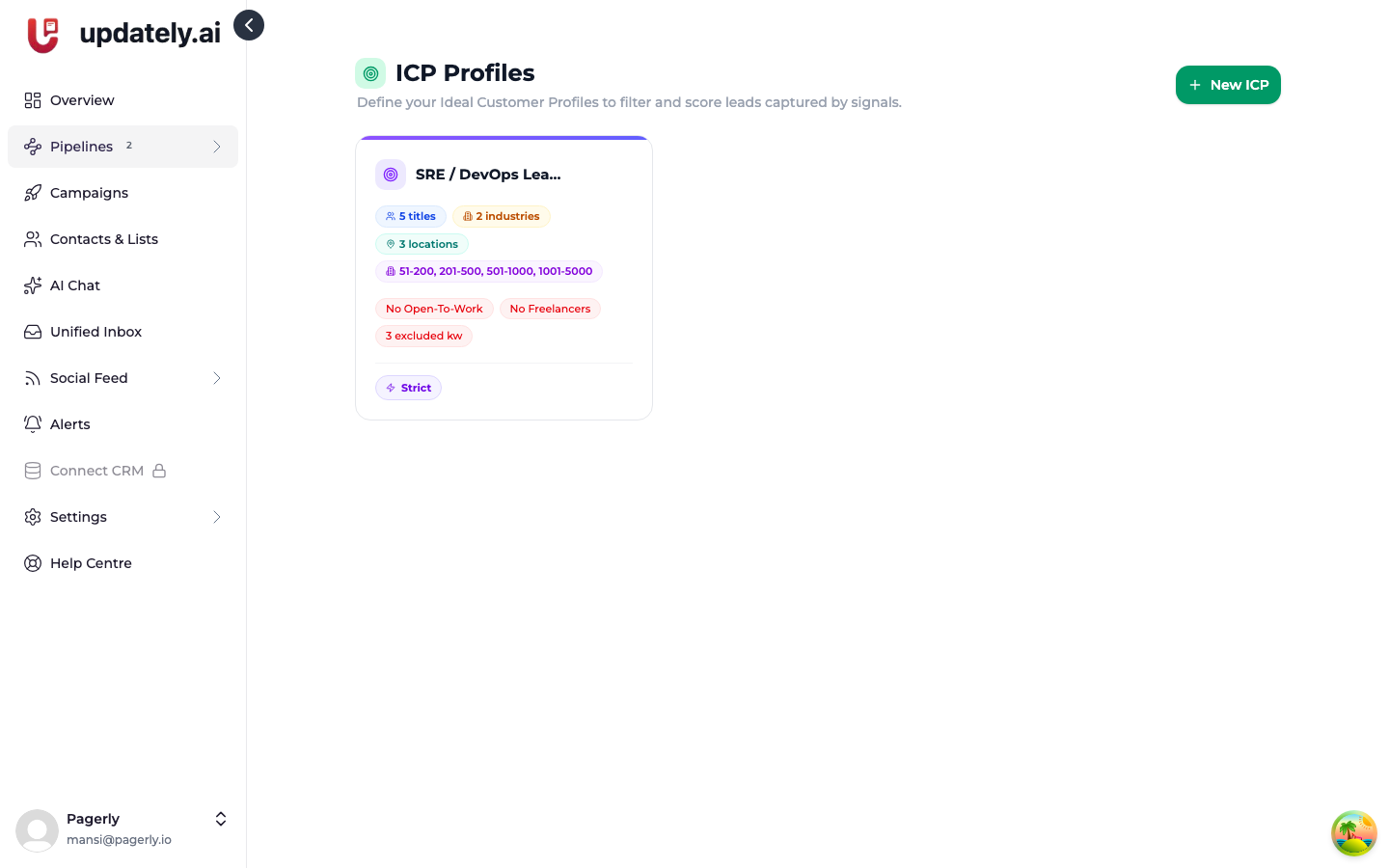
What to write
Describe who you sell to the way you'd describe it to a new salesperson:
- The roles that feel the pain and the ones that sign
- The kind of company — industry, business model, how they operate
- The size range that can afford you and needs you
- The signals that mean they're worth contacting now
Be specific about exclusions too. "Not agencies" and "not students" remove a lot of noise.
Matching modes
| Mode | Behaviour |
|---|---|
| High precision | Only clear fits get through. Lower volume, higher quality. |
| Broader | Anything plausible gets through. Higher volume, more noise. |
Start with broader while you're learning what your signals actually surface, then tighten once you can see the shape of what's coming in.
Scores
Each lead gets a fit score you can sort and filter by. Use it to work the best leads first rather than going in capture order.
A lead with no score hasn't been scored yet — that's different from scoring badly.
Why the filter matters more than it looks
The ICP filter genuinely rejects people. If your signal captures 12 leads and 10 match, 2 are dropped and never reach your list.
A very narrow ICP combined with a low-volume signal can produce almost nothing — and that's the filter working, not a bug. If your list stays empty, widen the ICP or the signal before assuming something is broken.
Leads need enrichment for this to work
You cannot filter on a job title that isn't there. If a batch of leads came in without titles or companies, the filter has nothing to judge and the scoring becomes unreliable.
See Leads are missing job titles.